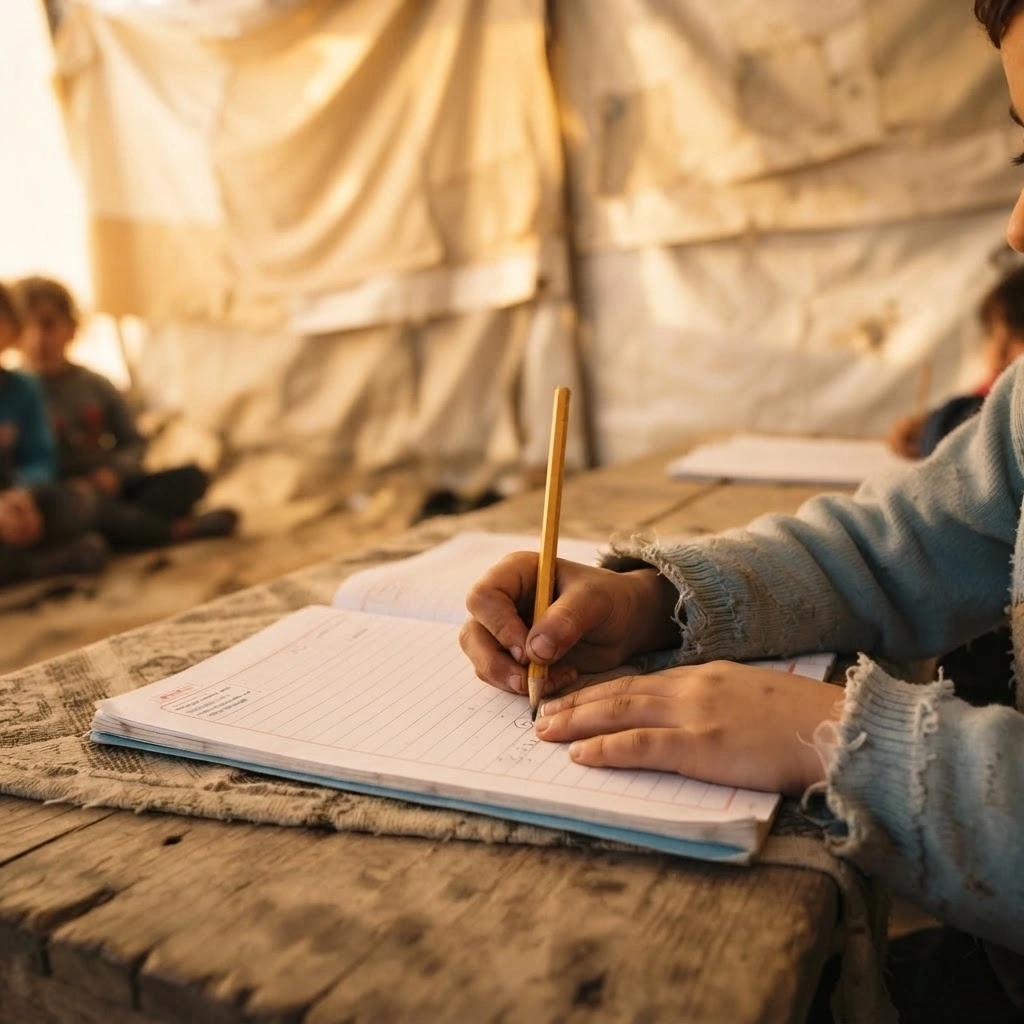
For some children in Gaza, going back to school means sitting on the ground. There may be no desks, no proper classroom walls, and too few notebooks to go around.
But there are lessons again. And for children whose education has been interrupted by years of war, that matters.
A new educational program aims to support 1,000 students across Gaza, helping them recover lost learning while giving them something equally important: a chance to reconnect with the experience of being a student.
A classroom, even without walls
On October 13, humanitarian organization People in Need described its Educational Enrichment Program, launched with local partner Al Nayzak.
The initiative is designed for 1,000 children in Grades 1–10, using temporary learning spaces across the Gaza Strip.
Students are being offered additional support in mathematics, science, Arabic, and English. The program also includes social and emotional learning and recreational activities intended to support children's well-being.
The need is enormous.
According to figures cited by People in Need from humanitarian education assessments, approximately 98% of Gaza's school buildings have sustained damage, and more than 200,000 children remain outside structured learning.
For many families, even ordinary school supplies are difficult to afford.
Temporary classrooms provide an alternative, but they cannot replace a properly equipped education system. Some students sit on the floor. Overcrowding and limited resources mean that lessons may last only a fraction of a normal school week.
The children behind the numbers
Independent reporting has captured what returning to school means to families.
In September, Reuters reported on children attending lessons in tents and makeshift classrooms, some returning to in-person education after years of disruption.
Their accounts describe both excitement and fear: happiness at seeing teachers and classmates again, alongside anxiety about safety, missing supplies, and the uncertainty surrounding daily life.
UNICEF has also been expanding access to temporary learning spaces, emphasizing that education provides more than academic instruction. For children living through prolonged upheaval, opportunities to learn, play, and connect with others can offer an important source of stability.
The People in Need program is one part of this wider effort.
Its announcement is not proof that Gaza's education crisis has been resolved. Nor does a target of 1,000 students establish that every participant has already received the full program or recovered lost learning.
But it represents a concrete effort to preserve education under extraordinarily difficult circumstances.